
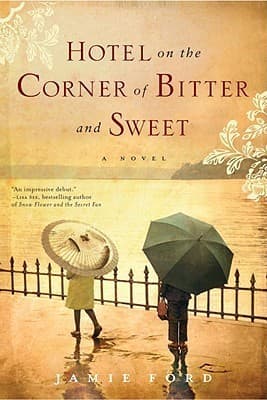
Hotel on the Corner of Bitter and Sweet
3.82
657 ratings·24,054 reviews
In 1986, Henry Lee finds himself drawn to the Panama Hotel, a relic of Seattle's Japantown. Sealed off for years, its secrets are about to be revealed: the forgotten possessions of Japanese families interned during World War II. As a Japanese parasol is unveiled, Henry, a Chinese American, is transp...
- Pages
- 300
- Format
- Paperback
- Published
- 2009-01-27
- Publisher
- Ballantine Books Trade Paperbacks
- ISBN
- 9780345505347
About the author

Jamie Ford
440 books · 0 followers
Jamie Ford’s debut novel,Hotel on the Corner of Bitter and Sweet, spent two years on the New York Times bestseller list and went on to win the 2010 Asian/Pacific American Award for Literature. Jamie’s work has been published in 34 languages. Also, because Jamie feels weird writing about himself in the 3rd person, he’s...
Readers also enjoyed




Rating & Review
What do you think?
Community Reviews
24,054 reviews3.8
657 ratings
5
45%
4
30%
3
15%
2
7%
1
3%

Debbie W.·1 years ago
Why I chose to read this book:
1. I'd seen tons of positive reviews on Goodreads, so when I snagged a copy of *Hotel on the Corner of Bitter and Sweet* at my local library's book sale, it went straight onto my TBR; and,
2. March 2025 is my "E and F Authors" Month!
Praises:
1. I learned so much about Seattle, WA during WWII, especially the vital role the iconic Panama Hotel played as a storage facility for Japanese-Americans when they were being forcibly relocated to internment camps. The Intern...

Dorie - Cats&Books :) ·7 years ago
This was my first ever audiobook, and what a great choice it turned out to be! Hearing the story read with Chinese accents from Henry and his family really made it come alive.
This is the story of Henry, a Chinese American born in America, and his family, including his rigid and anti-Japanese father.
Keiko is a second-generation Japanese American.
The two meet at a special school where they've both earned scholarships due to their intelligence. They're the two OUTCASTS in an otherwise all-wh...

J.L. Sutton·7 years ago
"I had my chance, and sometimes in life, there are no second chances. You look at what you have, not what you miss, and you move forward.”Jamie Ford's Hotel on the Corner of Bitter and Sweet was an easy book to get swept into. Henry Lee's search into his past is triggered by a discovery, at the Panama Hotel, of belongings from Japanese families who were sent to internment camps during WWII. Among those belongings, Henry is hoping to find one specific memory which connects him to the love of his ...

Peter·9 years ago
HopeHotel on the Corner of Bitter and Sweet is a captivating story of hope and love. Set against the backdrop of the politically charged era of World War II, it explores the divides that arose between Chinese, Japanese, and American people living side-by-side in the United States. Henry, a Chinese-American boy living in Seattle's Chinatown, finds an unlikely friend in Keiko, the only other non-white student at his school, a Japanese-American girl from Seattle’s Nihonmachi (Japantown) district. T...

Ariella·13 years ago
Oy vey. I really wanted to like this book. It sounded like the perfect book for my mood: not too highfalutin or literary, but a good story in which I could immerse myself and escape to a different time and place. As I went on Goodreads a few days ago to add the book to my list of 'currently reading,' however, I came across a number of really bad reviews. Disappointed, and somewhat deflated, I nevertheless read on, trying to ignore the negativity, stay positive, and try to like the story and get ...

Jason Koivu·14 years ago
Jamie Ford's highly praised and award-winning *Hotel on the Corner of Bitter and Sweet* left me feeling surprisingly indifferent. From beginning to end, the emotional impact I anticipated simply never materialized.
Considering the sensitive subject matter, the story should have evoked strong feelings, but it didn't. I never truly felt the sting of injustice as deeply as I should have. Learning about the Japanese internment in America during World War II was undoubtedly interesting, especially g...

Debra ·14 years ago
Set in Seattle during the Japanese internment of World War II, *Hotel on the Corner of Bitter and Sweet* has a wonderfully expansive feel. It starts slowly—not in a way that feels like watching paint dry, but slowly in a "this is really going somewhere" kind of way. And it absolutely does go somewhere. Once it gets going, the book sweeps you into the lives of two friends who made a promise to see each other again.
The story opens with Henry Lee standing in front of the Panama Hotel. The hotel h...

Jeff·17 years ago
Okay, let's be real: *Hotel on the Corner of Bitter and Sweet* is just as syrupy and sentimental as that title makes it sound. This is historical fiction for people who love Nicholas Sparks – an emotionally manipulative novel that’s competently told, but not exactly a literary masterpiece. Think of it as comfort reading with a side of historical context.
That said, there *are* some bright spots. Jamie Ford clearly did his research, and the historical elements are genuinely fascinating. The rela...

Nan·17 years ago
Original review posted: Mar 19, 09I have to admit, I didn't love this book. Jamie Ford is a decent writer, and while he clearly did his research on 1942, his portrayal of 1986 felt off. I was alive in '86. Ten years old, in fact. My memories might differ from a 50-year-old's, but the repeated anachronisms just got to me. In one paragraph—page four, I think—the narrator mentions the main character's son seeing a grief counselor and being in an Internet support group. In 1986, that would've been p...

Lynn·17 years ago
I absolutely loved "Hotel on the Corner of Bitter and Sweet" by Jamie Ford, although I did have one minor niggle. There were four little historical slip-ups: the book is partly set in 1986, but the son is participating in an "online" grief support group and uses the internet to track down a lost friend. Plus, there are two mentions of converting records to CDs.The story is narrated by a Chinese-American man in his fifties, reflecting on his life. It effortlessly weaves between two timelines: the...