
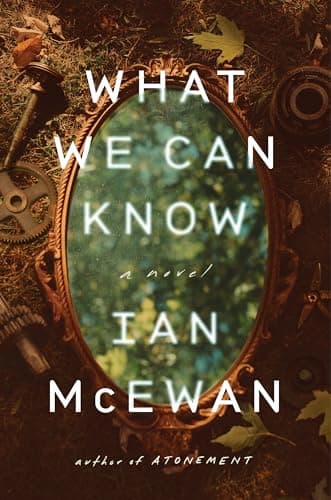
What We Can Know
4.73
1,430 ratings·4,107 reviews
A literary quest, a gripping thriller, and a poignant love story, What We Can Know traverses time to explore the depths of human identity and destiny. 2014: A legendary poem vanishes after its first reading, sparking generations of speculation. No copy survives. 2119: Rising seas engulf the UK's low...
- Pages
- 303
- Format
- Hardcover
- Published
- 2025-09-23
- Publisher
- Knopf
- ISBN
- 9780593804728
About the author
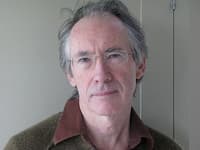
Ian McEwan
100 books · 0 followers
Ian McEwan studied at the University of Sussex, where he received a BA degree in English Literature in 1970 and later received his MA degree in English Literature at the University of East Anglia.McEwan's works have earned him worldwide critical acclaim. He won the Somerset Maugham Award in 1976 for his first collectio...
Readers also enjoyed
Rating & Review
What do you think?
Community Reviews
4,107 reviews4.7
1,430 ratings
5
45%
4
30%
3
15%
2
7%
1
3%

Angela M ·3 months ago
I've read seven other novels by Ian McEwan and enjoyed them all, captivated by his complex characters, fascinating storylines, and amazing writing. I can't say I enjoyed "What We Can Know" as much. Maybe it was my mood, or being busy this time of year. Whatever the reason, I had a hard time engaging. It felt like a rambling search for a missing poem written nearly a century earlier. I just couldn't connect to the obsession with finding the poem when England was no longer England and the world wa...

Fionnuala·4 months ago
The structure of this novel really caught my attention. There's a very intricate frame story, full of detail. If it were a picture frame, the beading and beveling would be so extensive that it would hardly need a picture inside it. But there *is* something inside it. A story that's even more elaborate than the frame story and which overflows into the frame story so much that it almost overwrites it. There is a passing mention at one point of a painting by the artist Howard Hodgkin. I looked up h...

Violeta·5 months ago
Clever. Canny. Hypnotic. And nearly impossible to review without giving away plot points and ruining the element of surprise that makes this book so appealing. Actually, it’s two books in one; that’s how different, in context and tone, the first half is from the second. ‘Hypnotic’ is an apt adjective, applying to both.
The first part takes place a hundred years from now and revolves around a supposedly magnificent poem written in 2014 and recited only once, before mysteriously disappearing from...

Adina ( catching up..very slowly) ·5 months ago
Having now read seven of Ian McEwan’s novels, I can consider myself a "connoisseur" of his work. Also, probably a fan, if you can say that about someone who DNFed one of his novels and gave 3 stars to three others. Anyway, I know his style and what I love about his books, when they fill me with the warm feeling of a really good read. What I also realised is that if I am to like a McEwan novel, I have to be entranced from the beginning. I will absorb every word, every sentence, no matter how slow...

Vit Babenco·5 months ago
What We Can Know paints a dystopian picture… another grim and satirical vision of a future we desperately hope to avoid.We're transported a century into the future… where radical climate change has transformed Great Britain into a fragmented archipelago. An academic arrives on the Isle of Bodleian Snowdonia Library to conduct a rather unusual research project…After breakfast, one of the assistant archivists, Donald Drummond, showed me to my carrel. His domain included my period, 1990 to 2030, an...

Henk·6 months ago
Guilt, as always with Ian McEwan, dominates **What We Can Know**, a novel that vaguely resembles Margaret Atwood's *Handmaid’s Tale*, with a reflective look at history. The core of human concerns and relationships remains surprisingly consistent across time.
*In love we forgot that we too were things that could get broken or lost.*
This is an interesting piece that follows a literature researcher in the early 22nd century. Life has changed drastically in many ways, yet in other ways, it hasn't...

Ron Charles·6 months ago
For years, Ian McEwan was nominated for the Booker Prize so often that the judges probably had his number on speed dial.
But then there came a moment—around 2016, let's say—when he published “Nutshell,” about a ruminative, vengeful fetus, and it felt like we might have lost McEwan to the kinds of weird little novels that writers produce after they win the Nobel Prize. The sex robot in “Machines Like Me” and the large insect serving as prime minister in “The Cockroach” suggested he’d caught late...

Maxwell·7 months ago
A novel of ideas with a mystery at its core, Ian McEwan’s 18th novel centers around, as the title suggests, just how much we can truly ever know – of the past, of others, and of ourselves. This makes it a must-read for fans of intellectual thrillers and literary fiction.
Thomas Metcalfe is a scholar of the humanities in 2119, obsessed with a poet, Francis Blundy, who was particularly active and successful in the late 20th and early 21st century. Blundy is particularly famous for a poem, ‘A Coro...

Samantha (Reading_Against_Noise)·8 months ago
I'm clearly going to be the outlier here, and I'm perfectly fine with that.
I just finished What We Can Know and I have mixed feelings. I flew through it, not because I was captivated, but because I wanted it to be over. It stirred up a lot of emotions, some good, but mostly bad. The book is split into two parts, and my feelings shifted dramatically between them.
Part One:
This started out promising. Ian McEwan's prose is undeniably beautiful, even if it leans heavily toward the dense side. I...

Maria·10 months ago
When I die, please, just put a copy of What We Can Know on my grave. That’s all I ask—thank you.
The story is a brilliant meditation on how we treat history—how we glorify certain eras and idolize their people, obsessing over times we never lived through, often wishing we had. It exposes the absurdity of that longing, especially through the eyes of a narrator who marvels at our present day, which to us feels unremarkable.
From there, Ian McEwan delves into deeper questions: What do we really k...