
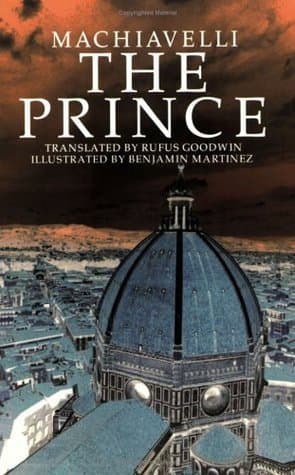
The Prince
4.65
504 ratings·16,382 reviews
Niccolò Machiavelli's "The Prince," a groundbreaking 16th-century treatise, dissects the acquisition and preservation of political power with ruthless pragmatism. Drawing from his experiences as a Florentine envoy, Machiavelli offers a starkly realistic guide for rulers, addressing challenges from m...
- Pages
- 134
- Format
- Paperback
- Published
- 2016-08-01
- Publisher
- CreateSpace Independent Publishing Platform
- ISBN
- 9781537319490
About the author
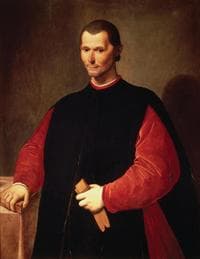
Niccolò Machiavelli
100 books · 0 followers
The Prince, book ofNiccolò Machiavelli, Italian political theorist, in1513 describes an indifferent ruler to moral considerations with determination to achieve and to maintain power.Niccolò di Bernardo dei Machiavelli, a philosopher, musician, and poet, wrote plays. He figured centrally in component of the Renaissance,...
Readers also enjoyed
The Fate of the Day: America's War, 1777-1780 (Revolution Trilogy, #2)
Rick Atkinson
J.R.R. Tolkien 4-Book Boxed Set: The Hobbit and The Lord of the Rings
J.R.R. Tolkien
One Day, Everyone Will Have Always Been Against This
Omar El Akkad
Larry McMurtry
The Devil Reached Toward the Sky: An Oral History of the Atomic Bomb
Garrett M. Graff
Rating & Review
What do you think?
Community Reviews
16,382 reviews4.7
504 ratings
5
45%
4
30%
3
15%
2
7%
1
3%

Luís·5 years ago
Machiavelli posits that human desires and states of mind remain constant throughout time. He delves into the past, seeking historical explanations for the realities of his present. This analysis allows for predictions of future events, suggesting that one can either repeat past successes or learn from failures to forge new paths. Machiavelli asserted that self-interest drives all men, devoid of personal ambition, pursuing material prosperity at any cost – *homo hominis lupus* (man is wolf to man...

Michelle·6 years ago
Okay, so it seems I've made a bit of a blunder here.I went into this completely blind, honestly expecting a wildly entertaining fictional tale about royalty. You can imagine my surprise when I dove into the first chapter of *The Prince* by Niccolò Machiavelli.I almost feel bad giving this one star, because it's entirely on me. That said, it ticks all the boxes for a truly unenjoyable read: I had to force myself to finish it, understood next to nothing, and the only relief I felt was finally reac...

Henry Avila·9 years ago
Italy in the early 1500s was a sad, dispirited land of constant wars, deaths, destruction, political betrayals, schemes of conquest by greedy aristocrats trying to enlarge their petty Italian states, invasion by ruthless foreign troops from France, Spain, and Switzerland, rulers being overthrown and killed, armies continuously marching, towns sacked, fires blazing, black smoke pouring into the sky, mercenary soldiers slaughtering the innocent, pestilence spreading—only the wise, the strong, and ...

Sidharth Vardhan·9 years ago
I can't believe I never reviewed this before! Recently, I was visiting a friend of mine in South India, Pramod (yes, the one from Goodreads), when he showed me this lesser-known piece, allegedly written by Niccolò Machiavelli in his last days. It's called 'Le Gente' and was never published—it's for common people about how they can succeed in social life using diplomacy.
Apparently, there were only twenty copies made in the 19th century, and Pramod's was one of them. Since he's a total book-wors...

فؤاد·10 years ago
Book TherapyHighly recommended for anyone interested in political analysis.Especially for those who are idealistic or have a simplistic view of politics, unaware of its complexities and ambiguities.MachiavelliNiccolò Machiavelli (1469-1527), one of the greatest political thinkers of the late Middle Ages and early Renaissance, is known for three key ideas:First, the criterion for the legitimacy of government is power."It is not reasonable to expect that one who is armed will obey one who is unarm...

Flo·12 years ago
This is no Little Prince, that's for sure. You must kill the fox, burn the rose, murder the businessman, if any of them tries to take control over your princedom. There's no time to be nice! There's only time to seem to be nice. At the end of the day, it is better to be feared than loved, if you can't be both. Nevertheless, keep in mind chapter 23.The Prince was written in the 16th century and a couple of its ideas are still shockingly relevant. It is a major treatise that influenced several pol...

هدى يحيى·13 years ago
I gave "The Prince" 3 stars for several reasons.While I disagree with the majority of his opinions, I see Niccolò Machiavelli as a very intelligent man who loves his country, Italy, in his own way.He also calls things by their names, which is what makes him honest in my eyes.I agree with Machiavelli in his view of life and people. As it says in the book's introduction, he sometimes said that he would not have offered some of the bitter, sarcastic sayings if people were averse to evil, and if som...

Hossam·15 years ago
There's no arguing that *The Prince* is incredibly shocking. In it, Niccolò Machiavelli expresses political opinions and ideas that clash with many principles and morals. His stance stems from a rule he himself established: "The end justifies the means." According to Machiavelli, everything is permissible for rulers and princes in pursuit of what humans universally desire: success, control, and power. To achieve this, a ruler is entitled to lie, break promises, be hypocritical, deceive their peo...

Sasha·16 years ago
I'm weirdly pleased that *The Prince* lives up to its reputation: it is indeed Machiavellian. Here's Niccolò Machiavelli's advice on conquering self-governing states (i.e. democracies): "The only way to hold on to such a state is to reduce it to rubble." Well then. I'd like to say that any guy whose last name becomes a synonym for evil is a badass, but Machiavelli wasn't; he was a failed minor diplomat who wrote this in a failed attempt to get reemployed. Stupid attempt, too; anyone who hired hi...

Stephen·17 years ago
That single statement, boys and girls, is the crux at the heart of the matter resting at the bottom-line of Niccolò Machiavelli’s world-changing classic on the defining use of realpolitik in governance and foreign policy. Despite popular perception, Machiavelli, whose name has often been used as a synonym for political ASSHATery, wasn’t arguing that it’s better to be immoral, cruel, and evil than to be moral, just, and good. Rather, Machiavelli was demonstrating, through reasoned analysis ba...