
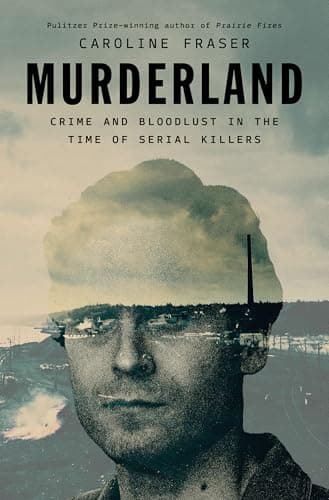
Murderland: Serial Killers and Toxic Landscapes
4.52
1,451 ratings·1,861 reviews
From the Pulitzer Prize-winning author of *Prairie Fires* comes a terrifying true-crime history exploring the serial killer epidemic in the Pacific Northwest. Caroline Fraser investigates how a surge of psychopaths emerged from a landscape of industrial violence, growing up in the shadow of Ted Bun...
- Pages
- 480
- Format
- Hardcover
- Published
- 2025-06-10
- Publisher
- Penguin Press
- ISBN
- 9780593657225
About the author
Caroline Fraser
8 books · 0 followers
Caroline Fraser was born in Seattle and holds a Ph.D. from Harvard University in English and American literature. Formerly on the editorial staff of The New Yorker, she is the author of two nonfiction books, God's Perfect Child: Living and Dying in the Christian Science Church and Rewilding the World: Dispatches from t...
Readers also enjoyed

Rating & Review
What do you think?
Community Reviews
1,861 reviews4.5
1,451 ratings
5
45%
4
30%
3
15%
2
7%
1
3%

Nevin·6 months ago
This book, Murderland: Serial Killers and Toxic Landscapes, wasn’t what I was expecting at all! Caroline Fraser did a fantastic job explaining how industrial factories polluted the environment and how it affected the residents. However, she didn’t quite explain why only men seemed to be affected and not women. All the serial killers who came from that area are men. How weird is that?!
Also, I am sooooo sick and tired of Ted Bundy… Enough already with that monster 🤮
Happy Reading 🍷
Also, I am sooooo sick and tired of Ted Bundy… Enough already with that monster 🤮
Happy Reading 🍷

Jillian B·9 months ago
What explains the disturbing concentration of serial killers in the Pacific Northwest during the 1970s and 80s? In "Murderland: Serial Killers and Toxic Landscapes", Caroline Fraser makes the compelling argument that heavy environmental pollution and its neurological impact might be a root cause. She meticulously traces this story through the 20th century, interweaving her own experiences growing up just outside Seattle during that terrifying serial killer era. I found Fraser's thesis both provo...
K
Katerina·9 months ago
Okay, buckle up – this is a long one, so apologies in advance!First off, I acknowledge that Caroline Fraser, the author of **Murderland: Serial Killers and Toxic Landscapes**, is a Pulitzer Prize winner, and I recognize the sheer amount of work that went into this book. However, this just… isn't it.**Murderland: Serial Killers and Toxic Landscapes** was never marketed as a memoir, yet Fraser's personal life and experiences are woven throughout. I'm fine with memoirs, but I want to *know* I'm rea...

Jenna·9 months ago
DNF somewhere between 20-30%. I grew up in a heavily polluted industrial area that still regularly appears on lists of top concern sites. So, maybe my cognitive abilities were affected by my childhood, but this audiobook made me feel absolutely insane and frustrated because it read like the author dropped the manuscript pages on the floor, picked them up randomly, and then bound them. After a strong intro, we briefly discuss the contamination of the Pacific Northwest, then it's on to bridges and...

Barbara K·9 months ago
Update: Here’s an article exploring the subject of serial killers in the Pacific Northwest. It’s a reasonable analysis of how the “population dynamics and vulnerabilities” of the area may have contributed to the seemingly high rate of serial killers operating there.. Article in Medium by Stacy Watts from May 28, 2023, 2 years before this book was published.My review of this book:Living in an age of conspiracy theories, most specifically the vaccine-autism connection, has made me suspicious of un...

Paul Bryant·9 months ago
This one just didn't click for me. After a while, I found myself skimming, hoping Caroline Fraser would eventually ease up on this dense, tangled weave of murder, memoir, industrial history, and her relentless Theory of Lead and Arsenic Poisoning. The theory, essentially, is that lead and arsenic infect the brains of certain men, contributing to them becoming serial killers. Given the abundance of these toxins in the Northwestern USA from the 60s to the 80s, it supposedly explains the disproport...

Sam·9 months ago
Is the subject matter interesting? Absolutely. But is it long-winded and dense? Oh my God, yes. The hypothesis here (from what I can gather, because it's never explicitly stated) is that the Pacific Northwest became a breeding ground for serial killers due to increased lead exposure and/or living near a major fault line. But really, it's just side-by-side timelines of serial killers and the smelting industry, peppered with random historical events for context. Why did Caroline Fraser describe he...

Celine·10 months ago
Caroline Fraser's *Murderland: Serial Killers and Toxic Landscapes* is a surprisingly beautiful piece of nonfiction that covers a lot of ground, but mainly focuses on a period when the Pacific Northwest saw a disturbing spike in serial killer activity.
There were times when I felt like Fraser tried to do too much, leaving me struggling to connect all the different threads. I think the section on bridges could have been cut, because everything else felt connected and was so well-executed.
What ...

Brendan (History Nerds United)·1 years ago
The Tacoma City Tourist Board probably won't be recommending *Murderland: Serial Killers and Toxic Landscapes* by Caroline Fraser, but I sure as hell am. I'm hesitant to reveal too much about the book's contents in this review. It's not really spoiler territory, but I went into it without knowing exactly how it would unfold, and I’m glad I didn’t. So, let me give you two reviews: a short one for those already intrigued, and then a longer one for those who are still on the fence.
For those alrea...

Lottie from book club·1 years ago
I've been relentlessly recommending "Murderland: Serial Killers and Toxic Landscapes" to everyone I've talked to this past week. My nightly reading sessions doubled because I kept reading huge sections aloud to my wife. I read it on the bus, on my walk to work, even standing in the kitchen waiting for the kettle. It completely blew my mind – like Mount St. Helens erupting.It's part true crime, part environmental history, part memoir, and part horror novella about a sinister bridge, all woven tog...